⭐ 5-Star Rated UK Studio | ⚡ Same-Day Dispatch on Eligible Orders | 🚚 Free UK Delivery over £20
How Leather Engraving Works: Process, 2 Types and Results
Learn how leather engraving works, which leathers give the best results and what to consider when choosing artwork for a personalised piece.

Leather engraving can turn an everyday item into something more personal, whether it carries initials, a name, a short message or a simple logo. The finished effect may look understated, but the quality of the result depends on much more than placing a design on a surface. The type of leather, its finish, the artwork and the chosen engraving method all matter.
This guide explains how leather engraving works, the differences between common methods and what to consider before choosing a design. It is useful background for anyone planning a personalised leather gift, accessory, label or branded item.
What is leather engraving?
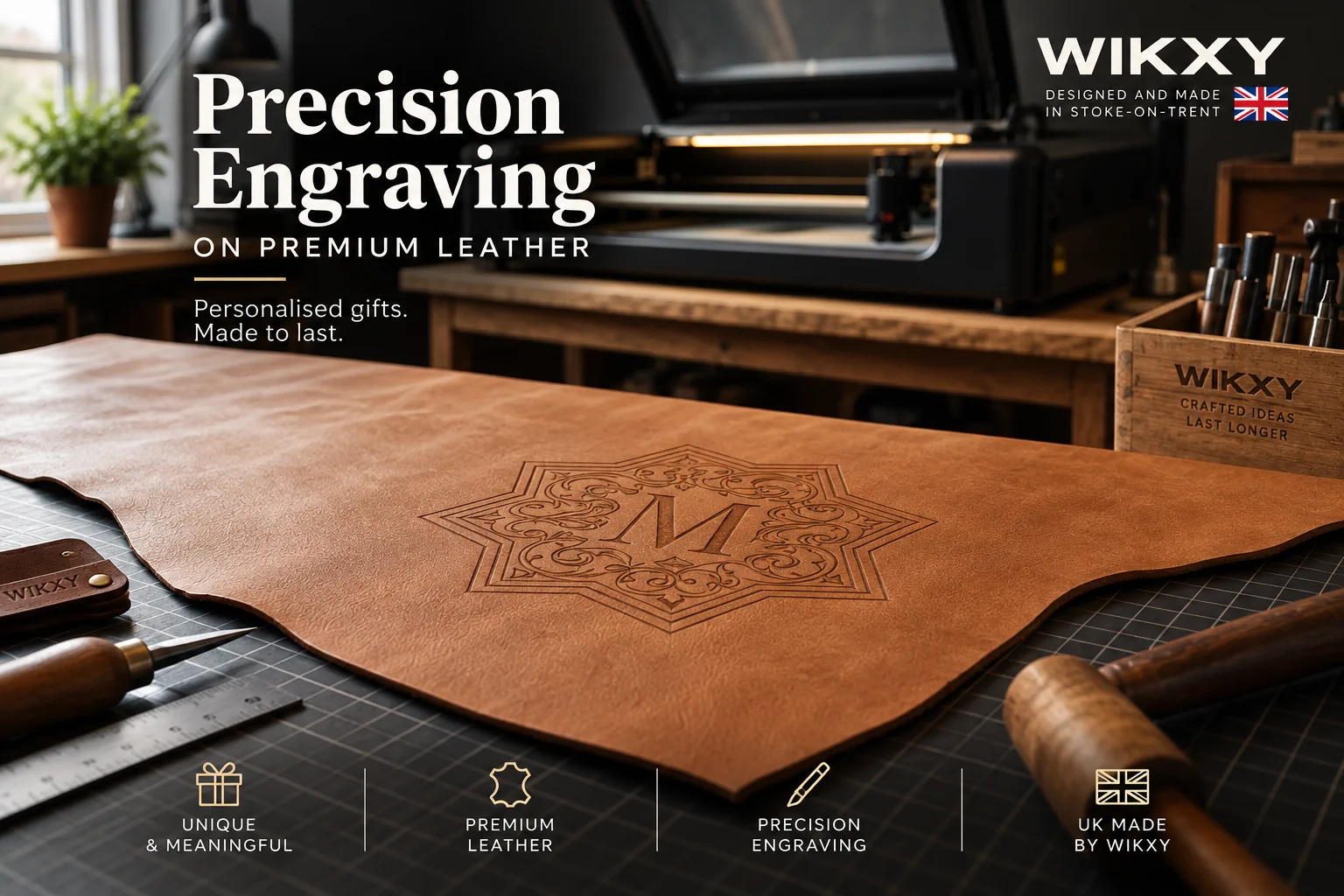
Leather engraving is the process of permanently marking a leather surface with a design, text or image. Depending on the method, the mark may be recessed into the material, darkened by heat, compressed into the surface or created through the removal of a fine top layer.
In modern personalisation, laser engraving is a common approach because it can reproduce crisp text and detailed digital artwork without needing a physical stamp for every design. Traditional hand tooling and hot stamping are also used in leatherwork, particularly where a deeper impressed finish or a more artisanal character is wanted.
It is worth separating engraving from printing. Printing places ink or foil on top of leather, whereas engraving changes the surface itself. An engraved mark is therefore usually more integrated with the material, although its appearance will still evolve as natural leather is used and develops a patina.
How leather engraving with a laser works
Laser engraving uses a tightly focused beam of light to apply controlled heat to a small area of leather. The laser head follows a digital file, moving across the material to form letters, lines, shapes or shaded artwork. At each point, the energy either darkens the surface, removes a tiny amount of it, or does both.
The result is typically a brown, dark brown or near-black mark against the leather’s natural colour. On some materials the engraving has a visible shallow recess; on others, the colour change is more noticeable than the depth. This is why two pieces of leather can produce very different-looking results with the same artwork.
From artwork to engraved design
The process starts with suitable artwork. Simple vector files are especially effective for names, monograms, logos and line drawings because the laser can follow clean paths accurately. High-resolution black-and-white artwork can also be used for more detailed images, with the laser varying the density of its marks to suggest lighter and darker areas.
Before engraving, the design needs to be sized and positioned to suit the available area. A large initial may work well on a leather panel, for example, while a narrow strip or curved piece may call for smaller type and a simpler layout. Fine details that look clear on a screen can become too close together once transferred to textured leather.
Setting the laser
The operator adjusts settings such as power, speed, focus and the number of passes. More energy generally creates a darker or deeper mark, but too much heat can scorch the surrounding area, make edges less sharp or create an overly burnt appearance. Too little energy can leave a pale, inconsistent result.
Thickness, colour, tanning method, surface coating and moisture content can all affect how leather responds. For that reason, a small test on an offcut or inconspicuous area is often the sensible way to establish settings before work begins on a finished piece.
Cleaning and finishing
Engraving can leave a small amount of residue or a smoky smell immediately after processing. Careful cleaning removes loose debris without damaging the engraved detail or the leather finish. The item should then be allowed to air appropriately before use or packing. Natural leather may continue to darken, soften and gain character over time, which can subtly change the contrast of an engraved area.
Which leather is best for engraving?
Not all materials sold as leather behave in the same way. A strong result begins with choosing a surface that is appropriate for the engraving method and the intended look.
Vegetable-tanned leather
Vegetable-tanned leather is often a popular choice for engraving and traditional tooling. It is usually firm, natural-looking and responsive to heat and pressure. Laser marks can develop good contrast, while physical stamping and tooling can create a clearly impressed design. Its relatively plain finish also allows the natural grain to remain part of the finished appearance.
Because it is a natural material, colour and grain variation are normal. These variations add character but mean no two engraved pieces will be identical.
Chrome-tanned leather
Chrome-tanned leather is widely used for softer, more flexible leather goods and is available in a broad range of colours and finishes. Some examples engrave well, but results can be less predictable than on vegetable-tanned leather. The surface may react with limited contrast, uneven darkening or a change in the finish around the mark.
Professional assessment and testing are particularly important with chrome-tanned or unknown leather. Leather should only be processed in suitable equipment with proper extraction and according to material and manufacturer guidance.
Dyed, coated and finished leather
Dyed leather can produce attractive tonal effects, especially where the laser reveals a lighter layer below a coloured finish. However, heavily coated, painted, waxed or glossy surfaces may melt, discolour or react unpredictably. A smooth finish can also make any positioning error more noticeable.
If colour consistency is crucial, it is better to work from a sample or test piece rather than relying on a description such as “genuine leather” alone.
Suede, nubuck and leather alternatives
Suede and nubuck have a raised nap that can make intricate engraving appear softer and less defined. They may be better suited to bolder text and less detailed artwork. Leather alternatives, including PU and bonded materials, vary greatly in composition. Some are designed for laser personalisation and can reveal a contrasting layer, while others are unsuitable for heat-based processing. The material specification should always be checked before engraving.
Laser engraving, debossing and hand tooling: what is the difference?
Several leather-marking methods may be described casually as engraving, but their finish is distinct.
- Laser engraving: A digital design is marked with controlled laser heat. It is well suited to personalised names, detailed linework and variable designs because no custom metal stamp is needed for each layout.
- Debossing or blind embossing: A stamp is pressed into leather to create a recessed impression. The effect can be subtle and tactile, often without a darkened mark.
- Foil stamping: Heat and pressure apply coloured or metallic foil through a stamp. It can create a high-contrast decorative finish, but the foil sits on or bonds to the surface rather than being an engraved leather mark.
- Hand tooling: Leather is dampened and shaped with individual tools. This is a traditional technique that can produce deep decorative patterns and a hand-crafted look.
The best method depends on the material, desired style, quantity and artwork. A fine illustration may suit laser engraving, while a simple maker’s mark repeated across many similar pieces may suit a physical stamp.
Choosing artwork that engraves clearly
A good design is not necessarily a complicated one. Leather has grain, natural marks and sometimes a textured finish, so artwork needs enough visual breathing room to remain legible.
Use clear fonts and sensible text sizes
Choose typefaces with open letter shapes and avoid very thin strokes for small text. Script fonts can be elegant, but closely connected letters and elaborate flourishes may merge on a textured surface. For a message, prioritise readability over fitting in as many words as possible.
Keep logos and line art clean
Logos should have distinct lines and sufficient space between details. Very small gaps, tiny isolated dots and hairline strokes may not reproduce consistently. If a logo contains complex shading, a simplified one-colour version is often more suitable for leather engraving.
Consider placement and shape
The flattest accessible area is generally easiest to engrave accurately. Seams, folds, hardware, heavy grain and curved sections can limit placement or affect focus. It is also important to account for the visible orientation of the finished item: a design should read the right way up when the item is being used or displayed.
What affects the finished colour and depth?
There is no single “correct” shade for an engraved leather mark. Results vary because leather is a natural material and because laser engraving is a heat-based process. Key influences include:
- the leather’s natural or dyed colour;
- the tanning process and any surface finish;
- grain, scars and natural variation in the hide;
- the leather’s thickness and firmness;
- the engraving settings and level of detail in the artwork;
- how the leather is later conditioned, handled and exposed to light.
These variables are part of the appeal of real leather, but they also mean a preview can indicate layout and wording rather than promise an identical final tone. If you need a completely uniform branded appearance across a project, testing the exact material is especially valuable.
Looking after leather engraving
Engraved leather should be cared for according to the leather manufacturer’s recommendations. In general, avoid soaking it, prolonged direct heat and harsh household cleaners. Use a suitable leather cleaner or conditioner sparingly where appropriate, and test any product on an inconspicuous area first.
Take care around the engraved section when applying creams or balms. Some treatments can deepen the overall colour of leather, reducing contrast temporarily or permanently. This is not necessarily damage; it is simply part of how leather ages. Regular gentle care will usually help preserve both the material and the clarity of the design.
Frequently asked questions
Is laser engraving leather permanent?
Yes. Laser engraving permanently changes the surface of the leather. It cannot be washed away like print, although wear, conditioning and natural ageing may alter its contrast over time.
Does engraving damage leather?
When the material is suitable for leather engraving and settings are properly controlled, engraving creates an intentional surface mark without compromising the item unnecessarily. Excessive heat, however, can scorch or weaken leather, which is why testing and material knowledge matter.
Can photographs be engraved on leather?
Photographs can sometimes be adapted for leather engraving, but they need good contrast and careful preparation. Portraits and images with clear light and dark areas tend to translate better on leather engraving than busy, low-contrast photographs. Fine photographic detail may be less distinct on heavily grained leather.
Can you engrave any leather item?
No. Construction, coatings, unknown material composition, curved surfaces and heat-sensitive finishes can all make an item unsuitable. It is best to confirm the material and assess a practical test area before committing to a design.
A considered approach gives the best result
Leather engraving works best when the material, design and method are chosen together. A short, well-spaced leather engraving message on suitable leather can often look more effective than an overly detailed design. Testing, sensible leather engraving artwork preparation and realistic expectations about natural variation are the foundations of a good leather engraving result.
If you are planning a personalised leather project and would like to discuss engraving-friendly artwork or materials, contact WIKXY for considered custom engraving advice.